

The Rule of Three in Psychology
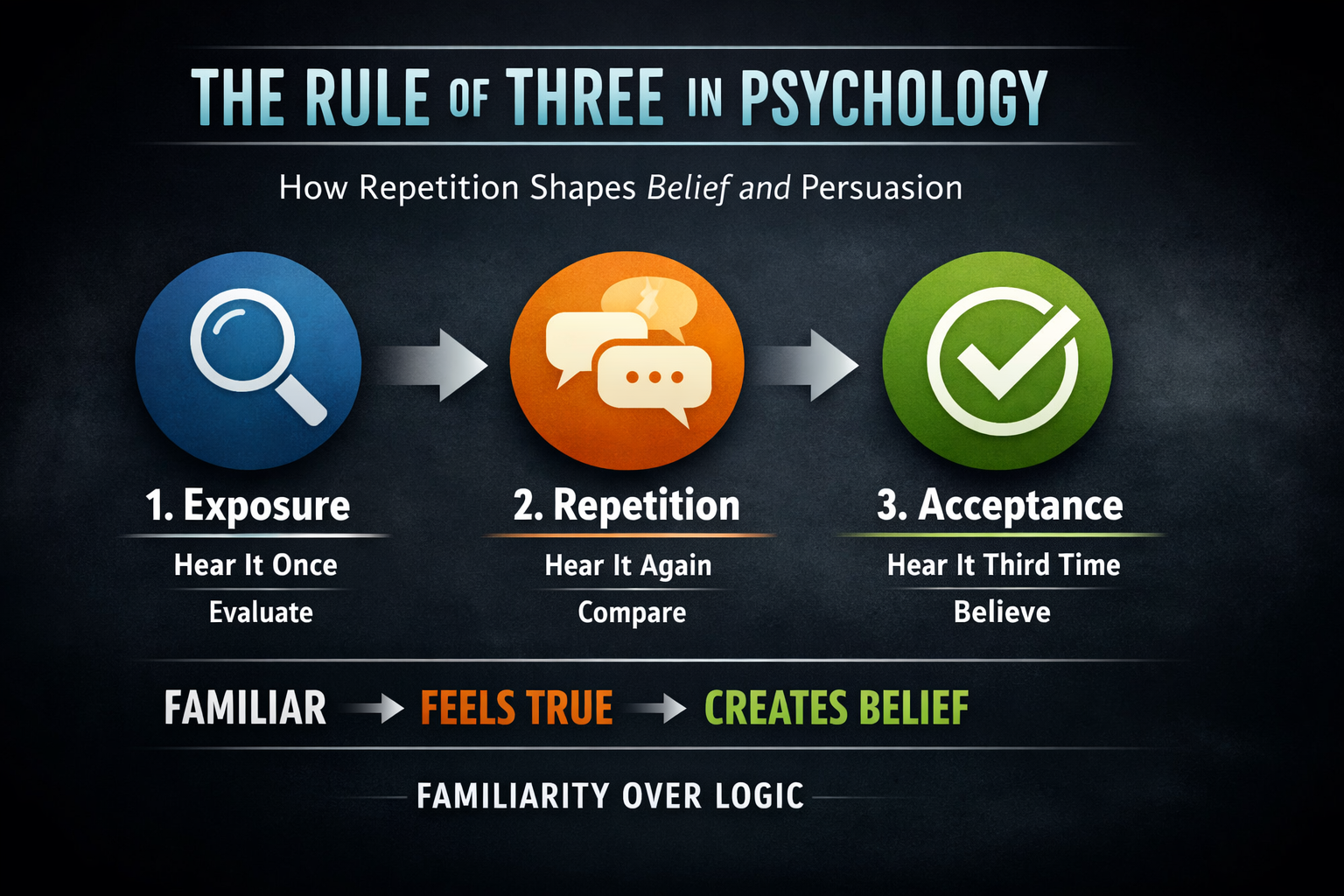
The Rule of Three refers to the psychological effect where a message repeated three times becomes familiar, believable, and cognitively accepted.
After the first exposure, your brain evaluates.
After the second, it compares.
After the third, it begins to accept.
This shift does not require truth. It requires consistency.
Persuasion seldom occurs in an instant; rather, it happens gradually through repetition.
The Rule of Three is one of the most effective psychological influence patterns ever used. It appears simple and harmless, yet it quietly reshapes perception, lowers resistance, and installs belief. Once you recognize it, the pattern becomes impossible to ignore.
What Is the Rule of Three
The Rule of Three refers to the psychological effect where a message repeated three times becomes familiar, believable, and cognitively accepted.
After the first exposure, your brain evaluates.
After the second, it compares.
After the third, it begins to accept.
This shift does not require truth. It requires consistency.
Why the Brain Responds to Repetition
Your brain is designed for survival, not perfect accuracy. Familiar information feels safer and requires less energy to process. Repetition signals predictability, and reliability signals safety.
By the third repetition, your brain often stops analyzing and starts assuming.
That is not weakness. It is biology.
Where You See the Rule of Three Every Day
The Rule of Three shows up constantly:
Three similar talking points in a speech
Three emotionally loaded claims in a post
Three simplified explanations of a complex issue
It is common in media, marketing, politics, and personal persuasion. The goal is not depth. The goal is acceptance through familiarity.
How to Spot the Rule of Three
You are likely being influenced when you notice:
The same idea repeated three times using slightly different wording
Emotional language intensifying with each repetition
A clear conclusion pushed after the third statement
The third repetition is rarely informational.
It is persuasive.
When Repetition Becomes Manipulation
Repetition turns manipulative when:
Alternative viewpoints are excluded
Emotion replaces evidence
Fear, urgency, or identity is repeatedly targeted
At that point, the message is no longer about understanding.
It is about compliance.
Why Smart People Still Fall for It
Intelligence does not protect you from repetition. Familiarity operates below conscious awareness. In fact, analytical thinkers often assume they would notice manipulation, which makes the pattern even easier to slip past them.
Awareness is the defense, not IQ.
How to Defend Yourself
Pause after the third repetition
Ask what evidence has actually been provided
Identify which emotion is being activated
Seek one credible opposing viewpoint
Breaking the rhythm restores critical thinking.
A Simple Psychological Reversal
When you notice repeated messaging:
Mentally restate the message once
Remove emotional language
Evaluate it as a single claim
Three statements collapse into one idea.
One idea becomes testable.
Using the Rule of Three Ethically
The Rule of Three is itself neutral. It can be used responsibly for learning, habit formation, and education. The line is crossed when repetition removes choice instead of supporting understanding.
Influence becomes manipulation when consent disappears.
Final Thought
The most impactful messages are seldom dramatic. Instead, they are delivered with calmness, consistency, and repetition.
Familiarity does not equate to truth; it simply indicates that you have encountered it previously.
Psychological awareness should not be mistaken for paranoia; rather, it serves as a form of protection.